1955 W Grove Parkway STE 201 Pleasant Grove, UT 84062



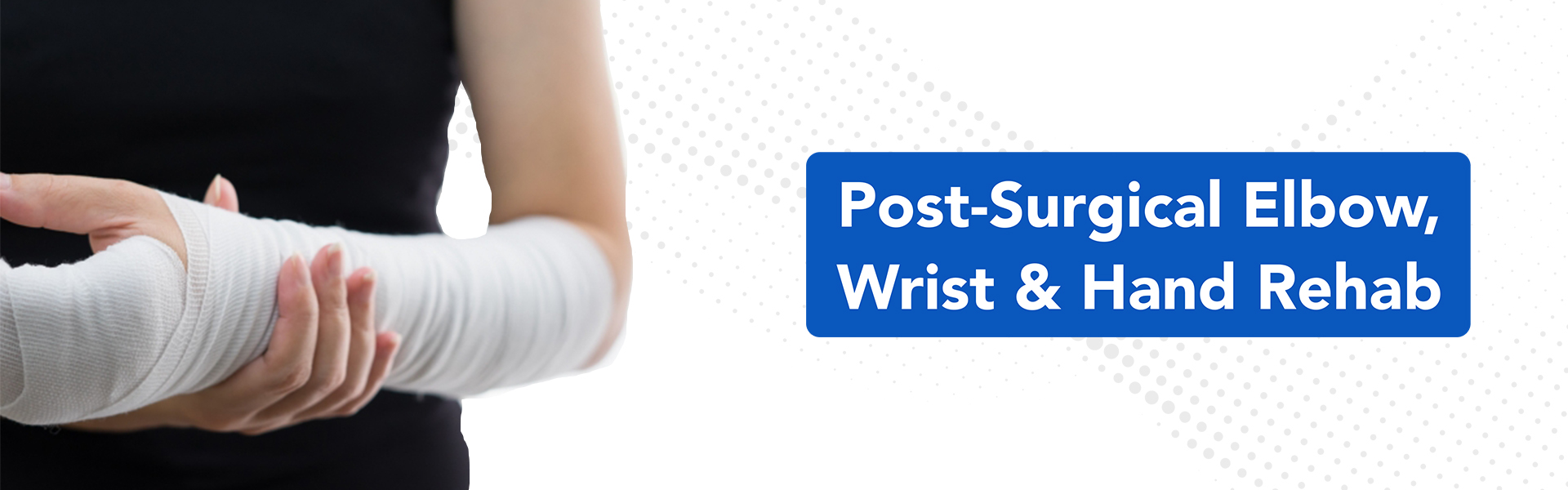
Post-Surgical Elbow, Wrist & Hand Rehab
From splints and stiffness back to grip, work, and everyday use.
Hand, wrist, and elbow surgery can feel small compared to “big” surgeries—but when you can’t grip, type, lift, or use your arm normally, it affects almost everything you do.
You might be thinking:
- “Why is this so stiff and puffy?”
- “When will I be able to grip or push myself up again?”
- “Is this normal healing pain, or am I overdoing it?”
At Timpanogos Physical Therapy, we help you move from protecting the repair to using your arm confidently again—at work, at home, and in the activities you enjoy.
Surgeries we commonly rehab
We regularly see patients after:
- Elbow surgeries
- Tendon repairs/debridements (e.g., tennis elbow/golfer’s elbow procedures)
- Ligament reconstructions (UCL, instability procedures)
- Elbow fracture fixation (plates, screws, pins)
- Contracture releases and debridements
- Wrist surgeries
- Distal radius and ulna fracture fixation
- Ligament repairs (e.g., scapholunate, TFCC)
- Carpal instability procedures
- De Quervain’s releases
- Hand & finger surgeries
- Carpal tunnel release
- Trigger finger release
- Tendon repairs (flexor and extensor)
- Finger fractures and dislocations
- Joint fusions or arthroplasties
We follow your surgeon’s protocol and restrictions (splinting, motion limits, lifting limits) and then customize your rehab based on your healing and your goals.
Common post-surgical challenges
After elbow, wrist, or hand surgery, people often struggle with:
- Stiffness when trying to fully straighten or bend the elbow, wrist, or fingers
- Swelling and puffiness that makes movement feel tight
- Pain or hypersensitivity around the incision or surgical area
- Weak grip or pinch that makes opening jars, carrying bags, or using tools hard
- Difficulty with typing, handwriting, lifting, pushing up from a chair, or weight-bearing on the hands
- Feeling like the arm or hand “doesn’t belong” to you yet
All of that is common—but you don’t have to stay there.
Our approach: protect, restore, then refine
We’ll always respect your surgeon’s timeline and tissue healing, then work step by step to restore motion, strength, and function.
Phase 1: Protect & gently restore motion
Early priorities include:
- Protecting the repair, hardware, or release
- Managing pain and swelling with positioning, gentle movement, and simple strategies
- Gradual range-of-motion within your allowed limits (often starting with passive or assisted movement)
- Keeping the shoulder, neck, and upper back from stiffening up while the elbow/wrist/hand is limited
We’ll help you understand exactly what you can safely do—and how to do it without flaring everything up.
Phase 2: Mobility, coordination & light strength
As restrictions ease, we focus on:
- Improving joint mobility in the elbow, wrist, and hand
- Restoring finger motion for opening/closing the hand, making a fist, reaching into pockets, and functional grip
- Beginning light strengthening and coordination exercises
- Re-training fine motor skills like buttoning, typing, writing, and using utensils/tools
The goal here is smoother movement and more confident use of the arm in everyday tasks.
Phase 3: Strength, endurance & real-world use
Once your tissues are ready for more load, we work on:
- Building strength and endurance in the forearm, hand, and upper arm
- Grip and pinch strength for lifting, carrying, work tasks, and recreation
- Weight-bearing on the arm (as appropriate), such as pushing up from a chair, floor tasks, or specific exercises
- Job- and hobby-specific activities—keyboard work, tools, racquets, bats, clubs, lifting, musical instruments, etc.
We’ll match your program to what you actually want to get back to—not just generic “hand exercises.”
Where our technology fits in
Shockwave therapy
When timing and healing allow, shockwave therapy can be beneficial around the elbow, wrist, and hand for:
- Persistent tendon pain (e.g., post-surgical tennis/golfer’s elbow, extensor/flexor tendon irritation)
- Chronic irritation at muscle/tendon attachment sites around the elbow or forearm
- Scar tissue and sensitive incision areas that feel thick, tight, or tender
Shockwave can:
- Decrease localized pain and hypersensitivity
- Help remodel and desensitize scar tissue, letting it move and glide more normally
- Support tissue circulation and healing, making strengthening and functional use more comfortable
We use it as part of a bigger plan—not as a stand-alone quick fix—and only when your surgeon’s healing timeline says it’s safe.
EMTT (Electromagnetic therapy)
We also use EMTT (Electromagnetic Transduction Therapy) around the elbow, wrist, and hand as a supportive tool to:
- Encourage local circulation and tissue health
- Help reduce deep, nagging muscle and soft-tissue soreness
- Support the healing environment for tendons and soft tissues that have been overloaded or immobilized
It’s non-invasive and comfortable, and we typically layer it in alongside exercise, manual therapy, and good movement retraining.
Red & near-infrared light therapy
Red and near-infrared light around the forearm, wrist, and hand can:
- Support recovery and tissue health
- Help ease post-session soreness or stiffness
- Compliment your strengthening and mobility work
It’s a simple, low-stress way to finish a session and can be especially nice when small joints and tendons are irritated.
Hands-on care & exercise: the foundation
The core of your rehab will still be good PT fundamentals:
- Manual therapy
- Gentle joint mobilizations for elbow, wrist, and hand joints as allowed
- Soft-tissue work to the forearm, upper arm, and hand muscles to reduce tension and improve glide
- Scar care
- When healing allows, we’ll show you how to mobilize and desensitize scars
- For stubborn or very sensitive scars, we may combine hands-on work with shockwave to improve comfort and motion
- When healing allows, we’ll show you how to mobilize and desensitize scars
- Strength & coordination
- Grip, pinch, forearm rotation, and elbow flexion/extension strength
- Fine motor drills for tasks like buttoning, handling small objects, typing, or tool use
- Movement & task training
- How to gradually return to lifting, carrying, pushing, pulling, and weight-bearing through the arm
- Strategies to make work, chores, childcare, and hobbies possible again—without overstressing healing tissues
We’ll always explain why we’re doing what we’re doing and adjust based on how your arm is responding, not just what the calendar says.
What progress can look like
As rehab moves forward, you may notice:
- Less stiffness and swelling in the elbow, wrist, or hand
- Better movement and comfort with reaching, grasping, and weight-bearing
- Stronger grip and pinch, making everyday tasks easier again
- Less fear around using the arm and more confidence in what it can do
- A gradual return to work tasks, hobbies, and exercise that felt impossible right after surgery
The timeline depends on the specific surgery, healing, and your starting point—but you don’t have to guess your way through it.
Ready to get the most out of your elbow, wrist, or hand surgery?
Surgery repairs structures. Rehab is what restores how you use your arm in real life.
Schedule a post-surgical elbow, wrist & hand rehab evaluation at Timpanogos Physical Therapy. We’ll build a clear, personalized plan—combining innovative, progressive exercises, hands-on care, and tools like shockwave, EMTT, and red light therapy when appropriate—to help you go from splints and stiffness back to confident, comfortable use of your arm.